

A practical guide to structure, performance, and long-term value
The choice between cast iron vs wrought iron lighting is not purely aesthetic—it determines how your fixture performs outdoors over decades. Both materials have deep roots in traditional architectural lighting, yet they behave very differently once installed. Here is what separates them.
At a Glance: Cast Iron vs. Wrought Iron
| Property | Cast Iron | Wrought Iron |
|---|---|---|
| Weight | Heavy | Heavy to very heavy |
| Surface Texture | Smooth; mold seams are visible | Hammer marks; hand-worked variation |
| Durability | Brittle; cracks under impact | Ductile; bends before breaking |
| Corrosion Resistance | Poor without ongoing maintenance | Excellent; slag inclusions resist rust |
| Repairability | Difficult once fractured | Can be re-forged or reshaped |
| Authenticity | Mold-reproduced | Unique; signed by the maker’s hand |
How to Tell the Difference Between Cast and Wrought Iron Lights
Identifying the material before you buy is straightforward when you know what to examine.
Start with surface texture—it is the most reliable tell. Cast iron comes out of a mold, so look for uniform smoothness interrupted by faint parting seams along decorative edges. Authentic hand forged wrought iron lighting, by contrast, shows subtle hammer marks, slight surface irregularities, and organic variation. Those aren’t flaws; they are the evidence of a blacksmith’s hand.
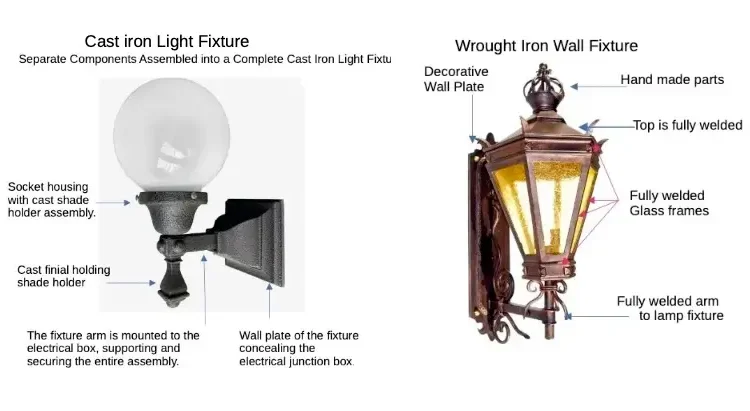
Next, examine the joints and connections. Cast fixtures typically use separately molded parts that manufacturers fasten together with hardware. Genuine handcrafted iron lighting fixtures, however, carry forge-welded connections—seamless joins that are stronger than the metal surrounding them.
Finally, ask about the production method. Makers of real wrought iron outdoor lights will readily describe their forge and their process. In contrast, vague language about “iron construction” or “traditional design” without specifics about fabrication is a clear red flag.
Cast Iron vs Wrought Iron Light fixtures
1. Cast Iron Lighting: Capable but Compromised
Manufacturers form cast iron by pouring molten iron (2–4% carbon) into molds. The process produces sharp, repeatable detail—ideal for ornate historical designs—yet the material carries meaningful structural limits.
That high carbon content creates a brittle microstructure. As a result, cast iron holds strong under compression but fails under impact and tension. A fixture dropped during installation may crack. Furthermore, once moisture breaches the exterior coating—through a scratch or hairline crack—rust forms beneath the surface, expands, and fractures the fixture from the inside out. At that point, repair becomes impractical.
For buyers weighing cast iron vs wrought iron lighting on price alone, this long-term maintenance burden is the cost that rarely appears in the initial quote.
2. Hand-Forged Wrought Iron Beats Cast Iron for Outdoor Lighting
Wrought iron is not poured—a blacksmith works it. The smith heats iron billets and shapes them by hand through hammering, twisting, and drawing. Because of this process, the result is a fundamentally different material.
Wrought iron’s low carbon content (below 0.08%) makes it highly ductile. Consequently, it bends under impact rather than shattering. A skilled smith can re-heat and reshape it, making field repairs possible in ways cast iron never allows. Beyond that, its fibrous slag inclusions—distributed throughout the metal during forging—interrupt rust propagation at the material level, not just at the coating. As a result, surface oxidation stays at the surface.
Heavy duty iron light fixtures built this way outperform cast iron on every metric that matters outdoors: corrosion resistance, impact survival, repairability, and service life. To put that in perspective, wrought iron fixtures from the 17th and 18th centuries still stand today—cast iron of the same era rarely survives intact.
Equally important is the authenticity argument. Every piece of authentic hand forged wrought iron lighting is unique—a specific person shaped it at a specific forge. The hammer marks and forge welds are not incidental; they are the product. That is something no mold can replicate.
3. One-Piece Construction vs. Assembled Cast Parts
Construction method matters just as much as material. Most cast iron fixtures are assembled from multiple separately cast components that manufacturers join with fasteners or welds. Each joint introduces stress concentration, a corrosion entry point, and the potential for mechanical loosening over time. From an engineering standpoint, therefore, every joint is a compromise.
Authentic hand forged wrought iron lighting built as a single continuous piece eliminates all of those vulnerabilities. The grain structure flows uninterrupted throughout. There are no joints to loosen, no seams to rust from the inside, and no hardware to back out over years of thermal cycling. For that reason, real wrought iron outdoor lights built this way earn their place in coastal environments, heritage restorations, and any installation where failure is simply not an option.
The Bottom Line: Why Wrought Iron Wins
For exterior architectural lighting built to last—genuinely last, not just look good for a few seasons—authentic hand forged wrought iron lighting in one-piece construction is the right specification. Cast iron offers ornamental appeal and a lower upfront cost, but it trades long-term reliability for short-term convenience.
When you compare wrought iron vs cast iron lanterns and sconces for any serious exterior project, the gap in service life, maintenance burden, and structural integrity is not marginal. Handcrafted iron lighting fixtures built by skilled blacksmiths cost more because craftsmen build them differently—and they perform accordingly.
Ultimately, the fixture hanging outside your home for the next century deserves the material that will actually get it there.


