

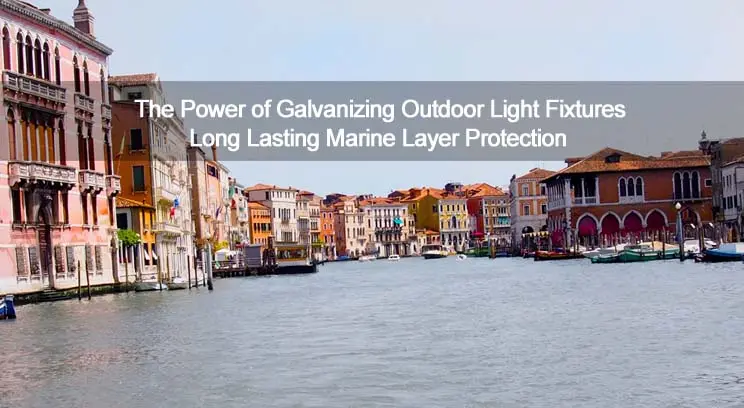
Wrought Iron Light Fixtures for Coastal Communities.
Why do your wrought iron light fixtures rust?
The Saltwater Effect: Why Wrought Iron Decays Like Wood
Wrought iron faces a unique battle with the sea because of its internal structure. Standard rust forms through a chemical reaction between iron, oxygen, and water, but the marine environment supercharges this process.
The Accelerator: Salt
Seawater acts as a highly effective electrolyte. It lets electrons move freely, creating microscopic electrochemical cells—essentially turning the metal into a battery that consumes itself. Chloride ions in salt aggressively penetrate the iron’s natural protective film, accelerating corrosion far faster than fresh water ever could.
A defining feature of wrought iron is the presence of slag—glass-like fibers of iron silicate physically mixed into the metal as part of its natural composition.
Selective Corrosion: Salt water attacks the pure iron but leaves the slag intact.
The Texture: As the iron washes away, the resistant slag stringers remain as raised ridges.
This process leaves the metal looking remarkably like old, weathered driftwood rather than the pitting seen in modern steel. The decay reveals the metal’s manufacturing history even as it destroys it.
Powder Coating’s Fight Against the Sea
Saltwater attacks powder coating through a relentless, multi-faceted electrochemical and physical assault, rapidly compromising its barrier function.
The most common failure occurs through osmotic blistering. Powder coating films are semi-permeable; when salt (chloride) gets trapped beneath or permeates the film, it acts as a powerful magnet. Water moves through the paint layer to dilute the salt, building intense internal pressure. This hydraulic force physically pries the coating off the metal, forming visible bubbles.
Once the coating loses integrity, the salt-rich solution accelerates electrochemical corrosion by acting as a powerful electrolyte. On aluminum, this often appears as filiform corrosion, where acidic saltwater tunnels beneath the paint in destructive, worm-like threads.
Surface degradation compounds the problem: intense UV light breaks down the polymer resin, causing the surface to chalk and become porous. This weakened outer layer allows saltwater to penetrate faster, turning the coating into a porous sieve that ensures failure of the underlying metal substrate.
What is the right fixture for a coastal community?
How to protect your light fixture from a marine layer and a harsh environment
What is galvanization, or the galvanization process?
Galvanizing coats steel or iron with a protective layer of zinc to prevent rust and corrosion. Manufacturers widely use this process to increase durability and longevity, especially for structures exposed to the elements. Hot-dip galvanizing remains the most common method, though electro-galvanizing also sees use.
Hot-Dip Galvanizing Process (Used as an upgrade for our lighting)
Surface Preparation:
Technicians clean the steel or iron to remove dirt, oil, and contaminants. This process typically includes:
- Degreasing: Removes organic materials such as oil and grease.
- Pickling: Immerses the metal in a dilute acid bath (usually hydrochloric or sulfuric acid) to remove rust and mill scale.
- Fluxing: Applies a zinc-ammonium chloride solution to prevent oxidation before dipping in molten zinc.
Galvanizing (Molten Zinc Dipping):
After cleaning, workers submerge the metal in molten zinc heated to approximately 450°C (840°F). Only solid wrought iron light fixtures can endure this process without warping due to the intense heat. The zinc bonds with the steel through a metallurgical reaction, forming multiple layers of zinc-iron alloy topped with an outer layer of pure zinc.
Cooling:
After removal from the zinc bath, the metal cools and solidifies, forming a strong, corrosion-resistant coating. This layer provides both barrier protection and cathodic protection—the zinc corrodes first, protecting the steel long term.
Inspection:
Inspectors check the galvanized steel to ensure uniform coverage, proper thickness, and adherence to specifications. They measure coating thickness and test surface uniformity and adhesion.
Types of Galvanizing
- Electro-Galvanizing: Applies zinc using an electric current in an electrolyte solution, producing a thinner, more uniform layer than hot-dip galvanizing. However, it offers less durability in harsh outdoor conditions.
- Continuous Galvanizing: Commonly used for products like steel sheets, where manufacturers pass the steel through a molten zinc bath in a continuous, high-volume process.
Benefits
- Corrosion Resistance: Zinc forms a strong shield against moisture, oxygen, and salt.
- Durability: Galvanized steel can last for decades with minimal maintenance.
- Self-Healing Properties: If the coating gets scratched, the surrounding zinc continues to protect the exposed steel by corroding first (cathodic protection).
Industries such as construction, automotive, and infrastructure rely heavily on this process.
How Galvanizing Protects Metal from Rusting
Galvanizing protects steel or iron by adding a thin zinc layer that blocks rust and corrosion. When exposed to air and moisture, untreated metal reacts with oxygen to form rust, weakening the structure over time. The zinc coating prevents water and oxygen from reaching the surface.
Even when the zinc layer gets scratched, it still protects the underlying metal through cathodic protection. Because zinc is more reactive than iron, it corrodes first, sacrificing itself to preserve the steel.
In short, galvanizing prevents rust by combining a physical barrier with an electrochemical defense, ensuring long-lasting protection for wrought iron light fixtures.
Sample of a galvanized light fixture

Picture on the left is a bare metal before galvanizing vs the right a bare metal with the deep galvanizing coating


